
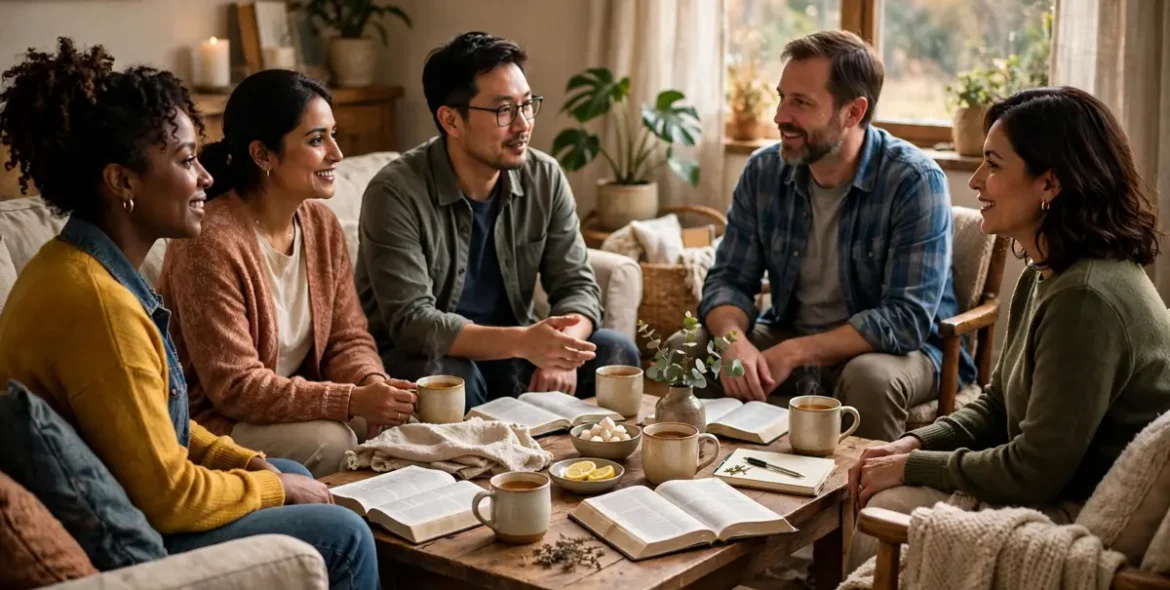
Large congregations can feel surprisingly lonely. You can attend a church for months, shake hands with the same friendly faces, and still have no one who truly knows you. That is exactly why so many churches are learning how to start a small group: a handful of believers meeting regularly in a home or church room to study the Bible, pray for one another and share everyday life. If your church is thinking about launching small groups, or you feel called to lead one, this practical guide walks through the steps that help a new group start well and keep growing.
Why Small Groups Matter in Church Life
The earliest church was built on small gatherings. Luke records that the first believers “devoted themselves to the apostles’ teaching and to fellowship, to the breaking of bread and to prayer” and that they met both in the temple courts and “in their homes” (Acts 2:42-46). Public worship and small fellowship were never rivals; they belonged together.
Small groups do what a Sunday service cannot. They give people space to ask questions, to be prayed for by name, and to notice when someone is missing. They are also where new believers are discipled most naturally, learning the Christian life by watching it up close. A church with healthy small groups tends to be a church where people stay, serve and grow.
Step One: Start With Prayer and a Clear Purpose
Before choosing a day or a study book, pray. Ask God who should be in the group, whom you might lead alongside, and what the group is for. Groups drift when their purpose is fuzzy, so decide from the start: is this group mainly for Bible study, for supporting young parents, for new Christians learning the basics, or for neighbours exploring faith? A clear purpose helps you invite the right people and choose the right material.
Talk to your church leadership early. Groups flourish when they are connected to the wider church rather than operating as a private club. Your pastor can advise on suitable study material, safeguarding expectations and how the group fits the church’s overall ministry.
Step Two: Choose Leaders and Set the Pattern
Every healthy group needs a leader and, ideally, a co-leader or host. The leader guides discussion and pastoral care; the host handles the practical welcome, the kettle and the seating. Sharing the load prevents burnout and means the group still meets when one of you is away.
Then settle the basics:
- When — pick a day and time most people can protect weekly or fortnightly, and state a clear start and finish time.
- Where — a home is warm and natural, but a church room can be easier for newcomers; choose somewhere with enough seating for everyone to sit in a circle.
- How long — ninety minutes is a good default: time to arrive, study, pray and talk without the evening disappearing.
- Size — six to twelve people is the sweet spot; beyond that, quieter members stop talking.
Step Three: Invite People Personally
Announcements from the front rarely fill a group; personal invitations do. Think of people on the edges of church life: the new family, the student far from home, the man who slips out before coffee. Invite them individually, explain what the group is and is not, and make the first visit easy by telling them exactly where to come and what to expect.
Aim for a mix. A group of people at different stages of faith, from the curious to the mature, usually produces the richest conversation, as long as everyone shares the same basic commitment to being there.
Step Four: Choose Study Material Everyone Can Use
For a first series, choose material that requires no homework and no prior knowledge. Studying a short book of the Bible together, such as Mark’s Gospel or the letter to the Philippians, works beautifully. Use simple questions: What strikes you? What does this teach about God? What will we do about it this week?
If your group is new to reading the Bible together, begin with a passage everyone can find and follow. Our complete list of the books of the Bible in order helps members navigate confidently, and a short series on scriptures on faith gives a new group encouraging, discussion-friendly material for its first weeks.
Step Five: Shape a Meeting People Want to Return To
A typical meeting might open with refreshments and unhurried conversation, move into the study for around forty minutes, and close with prayer in smaller clusters of two or three so that everyone can be prayed for personally. Guard the discussion kindly: draw out the quiet, gently limit the talkative, and never let anyone be made to feel foolish for an honest question.
Agree a few ground rules at the first meeting. What is shared in the group stays in the group. Everyone comes ready to listen as well as speak. And the group exists to build people up, not to win arguments about secondary issues.
Common Mistakes to Avoid
Most small groups that fail do so for predictable reasons. The first is treating the meeting as a lecture, where the leader talks for an hour and everyone else listens; people grow by wrestling with Scripture themselves, not by hearing it summarised. The second is letting prayer shrink to the final two minutes, which quietly teaches the group that prayer is an afterthought. The third is never inviting anyone new, so the group slowly turns inward and stops resembling the mission it was started for.
Leaders also burn out when they carry everything alone: the hosting, the study, the follow-up calls and the pastoral problems. Share the load from the first month. Ask one member to coordinate refreshments, another to keep the prayer list, another to organise the occasional social evening or act of service in the community. A group where everyone owns a small piece of the work is a group that lasts, and it develops future leaders without anyone noticing it happening.
Growing and Multiplying Over Time
A successful group will eventually face a happy problem: it becomes too big for real conversation. Rather than letting it harden into a social club, plan from the beginning to multiply. Train an apprentice leader from within the group, and when the time is right, send them out with a few members to start a second group. Churches grow this way, one living room at a time, as ordinary believers take ordinary steps of faith together. Start small, start prayerfully, and trust God with the increase.
