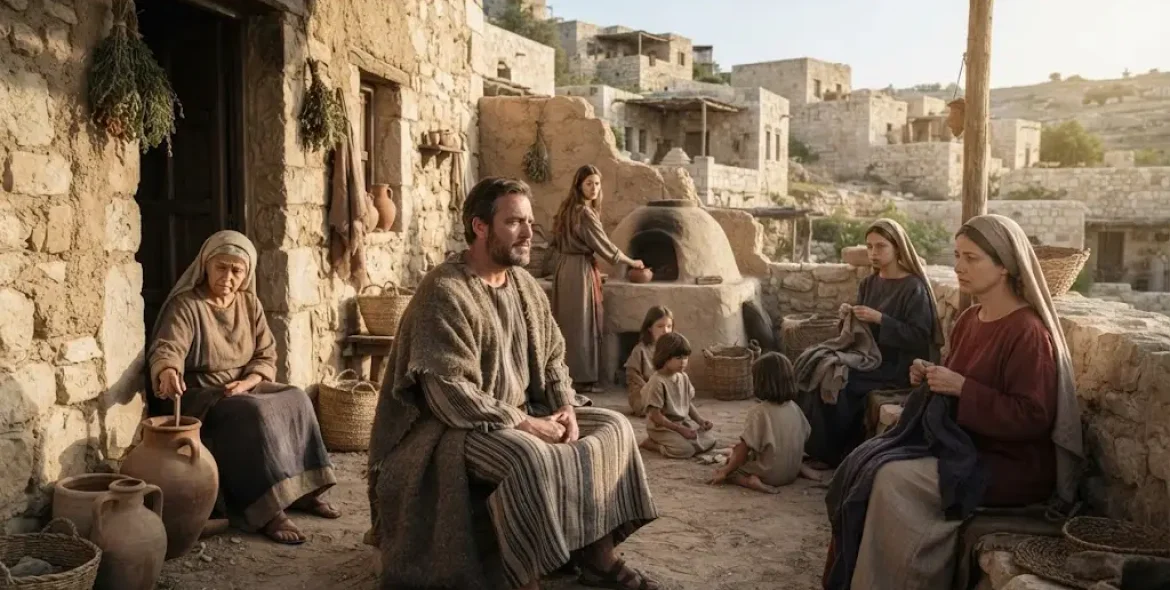
Polygamy in the Bible is a subject that often raises difficult questions. Several men in the Old Testament are described as having more than one wife, yet the Bible also presents marriage through the language of one man and one woman becoming one flesh. So does Scripture approve of polygamy, simply describe it as part of ancient society, or move toward a different understanding of marriage?
The answer requires looking at the Bible as a whole rather than relying on one isolated example. Scripture records multiple marriages, including situations involving several wives, but recording an event is not necessarily the same as approving it. The biblical accounts also frequently show jealousy, rivalry, family conflict, and other consequences associated with these relationships.
Understanding the subject requires examining both the creation account and the later examples of multiple wives in the Bible.
What Is Polygamy in the Bible?
Polygamy generally refers to marriage involving more than two spouses. In the biblical context, the discussion usually concerns polygyny, where one man has multiple wives.
The Old Testament contains several examples of men who had more than one wife. These include figures such as Lamech, Abraham, Jacob, David, and Solomon. Their stories occur in different circumstances, and the Bible does not present every relationship in exactly the same way.
This distinction is important. A historical or narrative passage can tell readers what happened without presenting every action as a moral model to follow. The Bible contains many accounts of human behaviour, including actions that lead to serious consequences.
What Does the Bible Say About Marriage at Creation?
One of the most important passages for understanding the Bible and polygamy is found near the beginning of Scripture. Genesis 2:24 describes a man leaving his father and mother, holding fast to his wife, and becoming one flesh with her.
This creation account establishes a foundational picture of marriage before the later biblical stories involving multiple wives. It describes a husband and wife forming a united relationship.
Jesus later refers to this same passage when discussing marriage in Matthew 19. He points his listeners back to creation, saying that the Creator made them male and female and that the two become one flesh.
The emphasis on “two” is significant for Christian discussions of marriage. Jesus’ teaching directs attention away from changing social practices and back toward the creation pattern.
Why Are Multiple Wives in the Bible?
One of the most common questions about the Bible and polygamy is why Scripture contains examples of multiple wives if monogamous marriage is presented as the creation pattern.
Part of the answer is that the Bible describes human history honestly. Biblical narratives include people who make wise decisions as well as people whose choices create suffering. The presence of an action in Scripture does not automatically mean that the action is commanded.
For example, Genesis records the jealousy and rivalry that developed between Sarah and Hagar, and later between Rachel and Leah. These family situations illustrate how complicated household relationships could become when marriage and childbearing involved multiple women.
Jacob’s family is another example. His relationships with Leah, Rachel, Bilhah, and Zilpah resulted in a complicated family structure involving rivalry and competition. The story does not read like a simple endorsement of multiple marriages. Instead, it repeatedly shows the emotional and relational difficulties within the household.
Abraham and Hagar: An Important Biblical Example
Abraham is one of the best-known biblical figures associated with a relationship involving more than one woman. Sarah was his wife, while Hagar became the mother of Ishmael after Sarah gave her to Abraham.
The account in Genesis 16 develops from Sarah’s inability to have children at that point in the story. Hagar subsequently became pregnant, and tension developed between the two women.
The story is significant because it demonstrates why biblical examples need to be read carefully. The narrative does not simply present Abraham’s household arrangement as an ideal family model. Instead, it records conflict, pain, separation, and complicated consequences.
For Christians studying polygamy in the Bible, such accounts provide an important distinction between what Scripture records and what Scripture establishes as the preferred pattern for marriage.
Jacob and the Rivalry Between Leah and Rachel
Jacob’s family provides another major example of multiple wives in the Bible. Jacob loved Rachel, but he was first married to Leah after being deceived by her father Laban. Jacob later married Rachel as well.
Both women wanted children, and the family became increasingly complicated as children were born through Leah, Rachel, Bilhah, and Zilpah.
The narrative contains repeated signs of rivalry. Leah experienced the pain of being less loved, while Rachel struggled with infertility before having children. Their competition affected the entire household.
This does not mean that every difficulty in the story was caused solely by polygamy. The circumstances were complicated. However, the account certainly does not portray a household with multiple wives as free from emotional or relational problems.
David and Solomon: Multiple Wives and Kingship
David and Solomon are also frequently mentioned when people study polygamy in the Bible.
The Old Testament records David as having multiple wives. His family history subsequently includes serious problems involving his children, including sexual wrongdoing, rivalry, rebellion, and violence.
Solomon’s situation was even more extensive. First Kings records that he had many wives and concubines. The passage connects these relationships with his later spiritual compromise, stating that his wives turned his heart toward other gods.
Solomon’s story is particularly important because the Bible explicitly connects his relationships with a serious spiritual problem. His experience therefore cannot reasonably be treated as a straightforward biblical endorsement of having multiple wives.
Does the Bible Command Polygamy?
No. The Bible does not command Christians to practise polygamy.
The Old Testament regulates certain situations involving marriage and family relationships, but regulation should not automatically be interpreted as approval or command. Ancient Israelite law sometimes addressed practices that existed within society without presenting those practices as the ultimate pattern for human relationships.
Jesus’ teaching on marriage is particularly important for Christian interpretation. In Matthew 19, Jesus appeals to Genesis and speaks about the man and his wife becoming one flesh. His response places the creation account at the centre of the discussion.
This is one reason Christian teaching has historically understood marriage as a union between one man and one woman.
What About Deuteronomy and Laws Concerning Multiple Wives?
Some readers point to Old Testament laws that mention situations involving a man with two wives. One example appears in Deuteronomy 21:15-17, where inheritance rights are addressed when a man has two wives.
The existence of such legislation can initially appear to suggest approval. However, the purpose of the passage is to regulate inheritance fairly rather than to command men to marry multiple women.
This is an important principle when reading biblical law. A law can regulate an existing social situation without establishing that situation as the ideal pattern for everyone.
Jesus’ later teaching about marriage should therefore also be considered when Christians develop a theology of marriage from the whole Bible.
What Did Jesus Teach About Marriage?
Jesus addresses marriage in Matthew 19 when questioned about divorce. Rather than beginning with the social customs of his time, he goes back to creation.
He refers to Genesis and explains that the Creator made humanity male and female. He then quotes the principle that a man will leave his father and mother and be united with his wife, with the two becoming one flesh.
This teaching is central to Christian discussions about marriage because Jesus presents the creation account as the foundation for understanding the marital relationship.
For Christians, this means that examples of multiple wives in earlier biblical narratives should be interpreted alongside Jesus’ teaching rather than treated as independent evidence that polygamy is God’s intended model.
What Does Christianity Say About Polygamy?
Christianity on polygamy has generally understood marriage as monogamous. This conclusion is based on the creation account, Jesus’ teaching about marriage, and the New Testament’s presentation of Christian family relationships.
For example, when Paul discusses qualifications for church leadership, he uses the phrase “husband of one wife” in 1 Timothy 3 and Titus 1. These passages have been interpreted in different ways regarding their precise application, but they are part of the wider New Testament context in which monogamous marriage is the normal Christian pattern.
Paul’s teaching in Ephesians 5 also presents Christ and the church as an analogy for the relationship between a husband and wife. Husbands are instructed to love their wives sacrificially, while the wider passage describes marriage through the language of unity and commitment.
For more detail on that teaching, see our guide to what the Bible says about husbands loving their wives.
Does the Bible Condemn Every Person Who Practised Polygamy?
This question needs a careful answer. The Bible records polygamous relationships involving people who are also presented as important figures in biblical history. Abraham, Jacob, David, and Solomon all occupy major places in Scripture.
However, their importance does not mean that everything they did was approved by God. Biblical heroes are often presented with remarkable strengths alongside serious weaknesses.
David is described as a man after God’s heart, yet Scripture also records his adultery with Bathsheba and his involvement in her husband’s death. Solomon was given extraordinary wisdom, yet his later actions led him into serious spiritual compromise.
The Bible’s willingness to record the failures of its major figures is part of its overall honesty. Therefore, readers should distinguish between recognising that someone practised polygamy and concluding that God commanded or endorsed the practice.
Polygamy, Jealousy and Family Conflict
Several biblical narratives involving multiple wives contain significant family tension. This is not necessarily presented as a universal mathematical rule that every polygamous household will experience the same problems. Rather, the repeated stories demonstrate the difficulties that can arise when marital relationships become divided.
Competition for affection, disagreements about children, inheritance disputes, jealousy, and unequal treatment can create serious family pressures.
The stories of Sarah and Hagar, Leah and Rachel, and Solomon’s many wives each demonstrate different dimensions of family complexity.
These narratives can therefore help modern readers think about why the Bible’s later emphasis on one-flesh marital unity matters. A marriage built around mutual commitment requires spouses to protect trust and treat one another with dignity.
Polygamy in the Bible and Christian Marriage Today
For Christians today, the question is not simply whether some biblical figures had multiple wives. The more important question is what pattern the New Testament gives to Christian believers.
Christian marriage is generally understood as an exclusive covenant between one husband and one wife. This understanding reflects the creation account, Jesus’ teaching, and the New Testament’s broader approach to marriage.
It also connects with the practical responsibilities of marriage. Faithfulness, mutual care, sexual exclusivity, communication, and shared commitment are easier to understand when marriage is treated as an exclusive relationship rather than one that permits multiple spouses.
Christians considering marriage may also encounter questions about differences in religious belief. Our guide on whether a non-Christian can marry a Christian explores that separate issue in greater detail.
How Should Christians Read Difficult Biblical Marriage Passages?
Passages about marriage can become confusing when readers approach them as isolated statements. A better approach is to consider the historical context, literary context, immediate passage, and the broader biblical teaching.
When studying polygamy, it is especially important to ask whether a passage is describing an event, regulating an existing practice, commanding a behaviour, or presenting an ideal.
This approach prevents a common interpretive mistake: assuming that everything recorded in the Bible is automatically presented as an example to imitate.
It also allows readers to recognise the development of biblical teaching. The Old Testament contains narratives and laws arising within ancient Israelite society, while Jesus and the New Testament writers provide further teaching for the Christian understanding of marriage.
Polygamy in the Bible: The Main Takeaway
The Bible does contain accounts of men with multiple wives, so it would be inaccurate to claim that polygamy is absent from Scripture. However, the presence of these relationships does not establish polygamy as the biblical ideal for Christian marriage.
The creation account presents a man united with his wife as one flesh. Jesus returns to this creation pattern when teaching about marriage. The New Testament then continues to describe marriage through exclusive commitment, faithfulness, love, and unity.
The stories involving multiple wives also frequently reveal complicated consequences, including jealousy, rivalry, family conflict, and spiritual compromise. These accounts should therefore be read as part of the Bible’s broader story rather than as simple endorsements of the practice.
For Christians, the strongest foundation for understanding marriage comes from considering Scripture as a whole. The biblical picture points toward a committed, faithful relationship in which husband and wife seek to honour God and care for one another.
That broader understanding also helps explain why Christian teaching on marriage has generally remained monogamous, even though the Old Testament records several examples of polygamy.