

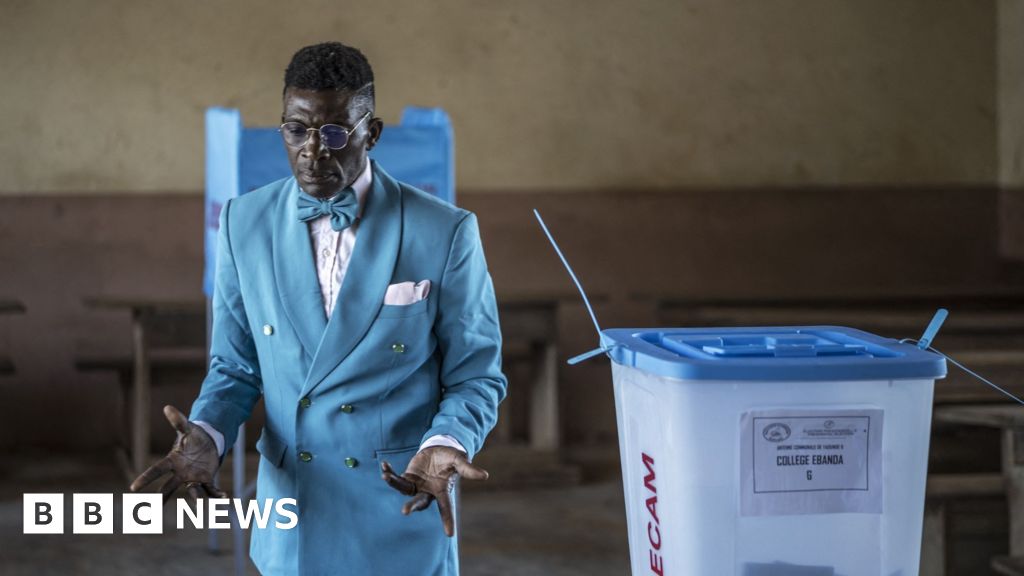
Judges in Cameroon have dismissed requires the partial or complete cancellation of the closely disputed presidential election, saying they may announce the outcome on Monday.
Main cities within the nation have been rocked by protests, with opposition supporters alleging that the 12 October ballot was marred by irregularities, together with ballot-stuffing.
Judges on the Constitutional Council dismissed eight petitions, citing inadequate proof of irregularities or an absence of jurisdiction to annul outcomes.
Opposition candidate Issa Tchiroma Bakary has declared himself the winner – a declare rejected by allies of 92-year-old President Paul Biya, who’s in search of one other seven-year time period.
Biya has been in energy for 43 years, and addressed just one marketing campaign rally forward of the election.
Tchiroma Bakary, 76, is a former authorities spokesman who broke ranks with Biya to problem him for energy.
He refused to file complaints with the Constitutional Council, whose judges have been appointed by Biya, selecting as an alternative to declare himself the “authorized and bonafide president”.
In a video assertion posted on social media, Tchiroma Bakary stated he had received the election with about 55% of the vote, primarily based on what he waid had been returns representing 80% of the citizens.
“If the Constitutional Council proclaims falsified and truncated outcomes, it will likely be complicit in a breach of belief,” he declared.
Tchiroma Bakary additionally warned that “with their backs towards the wall, the folks can have no alternative however to take their future into their very own fingers and search victory wherever they will discover it”.
Biya’s ruling celebration has dismissed his claims of victory and several other officers have described it as unlawful as a result of solely the Constitutional Council can proclaim official outcomes.
The influential Catholic Church this week urged the judges to make sure that the decision mirrored the desire of voters.
The rising tensions have sparked fears of post-electoral violence in a rustic already rocked by a separatist battle within the Anglophone areas and Boko Haram insurgency within the Far North area.
