

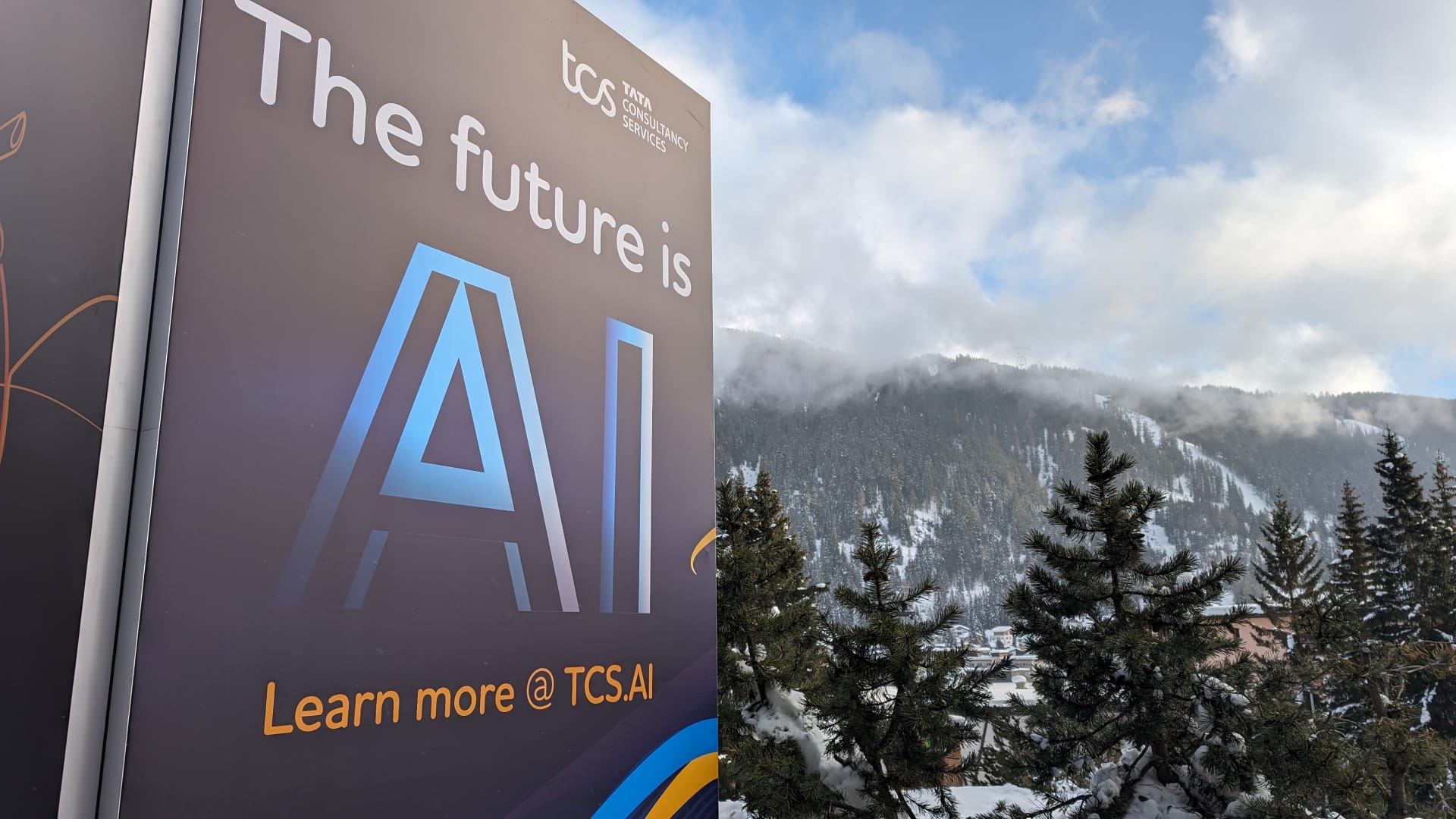
Corporations touting their synthetic intelligence merchandise dominated the Promenade, the principle street in Davos. In previous years on the World Financial Discussion board annual assembly, cryptocurrency companies had been essentially the most outstanding down the Promenade. However AI fever has taken over in 2024.
Arjun Kharpal | CNBC
“We few, we completely happy few, we band of brothers.” The rallying cry from Shakespeare’s Henry V, forward of the Battle of Agincourt, would possibly as effectively be the motto of immediately’s synthetic intelligence elites.
Final night time, OpenAI unveiled a partnership with AMD, by which it’ll deploy 6 gigawatts of the latter’s Intuition graphics processing models to energy its AI infrastructure. The deal features a warrant for OpenAI to accumulate as much as 10% of AMD.
That comes after OpenAI’s $100 billion pact with Nvidia.
OpenAI was additionally the catalyst for a surge in Figma shares after CEO Sam Altman promoted the design software program vendor’s expertise in an onstage demo.
However as our U.S. colleagues have pointed out, the association between OpenAI and AMD provides a brand new layer to the more and more round nature of AI’s company economic system, the place capital, fairness and compute are traded among the many identical handful of corporations constructing and powering the expertise.
Nvidia is supplying the capital to purchase its chips. Oracle helps construct the websites. AMD and Broadcom are stepping in as suppliers. OpenAI is anchoring the demand.
It is a tightly wound round economic system, and one which analysts concern might face actual pressure if any hyperlink within the chain begins to weaken.
Because the AI arms race accelerates, the query looms — can this “band of brothers” carry the burden of a whole business’s expectations?
And, similar to the Battle of Agincourt, can they be remembered not for his or her numbers, however for his or her influence on the AI area?
— CNBC’s MacKenzie Sigalos contributed to this report.
What you must know immediately
OpenAI-AMD announce deal. That would see Sam Altman‘s firm take a 10% stake in the chipmaker. OpenAI will deploy 6 gigawatts of AMD’s Intuition graphics processing models over a number of years and throughout a number of generations of {hardware}. Shares of AMD skyrocketed 23.71% Monday following the information.
Figma rides OpenAI hype. The design software vendor’s stocks climbed 7% after Altman mentioned Figma’s integration into ChatGPT, and confirmed how third-party purposes might plug in with OpenAI’s Apps software program improvement framework.
Tesla teases potential new automobile mannequin. Tesla shares rose greater than 5% Monday after the electrical automobile maker posted a teaser video on X, sparking hypothesis that the corporate may very well be gearing up to release a new car.
S&P and Nasdaq attain new information. On Monday stateside, both indexes were spurred by optimism about elevated M&A exercise after two main offers had been introduced, specifically, the OpenAI-AMD partnership, and Fifth Third Bancorp’s agreement to purchase fellow financial institution Comerica for $10.9 billion. In Europe, the Stoxx 600 ended the day little changed.
[PRO] Three huge bets outdoors the U.S. Bridgewater Associates has recognized three key markets which it says can present a layer of resilience to portfolios as traders’ equities exposures hit all-time highs.
And at last…
Paul Tudor Jones talking on the World Financial Discussion board in Davos, Switzerland, January 21, 2020.
Adam Galica | CNBC
Billionaire hedge fund supervisor Paul Tudor Jones believes the situations are set for a strong surge in inventory costs earlier than the bull market tops out.
“My guess is that I feel all of the elements are in place for some sort of a blow off,” Jones stated Monday on CNBC’s “Squawk Box.”
The founder and chief funding officer of Tudor Funding stated immediately’s market is paying homage to the setup main as much as the burst of the dot-com bubble in late 1999, with dramatic rallies in expertise shares and heightened speculative conduct.
— Yun Li
