

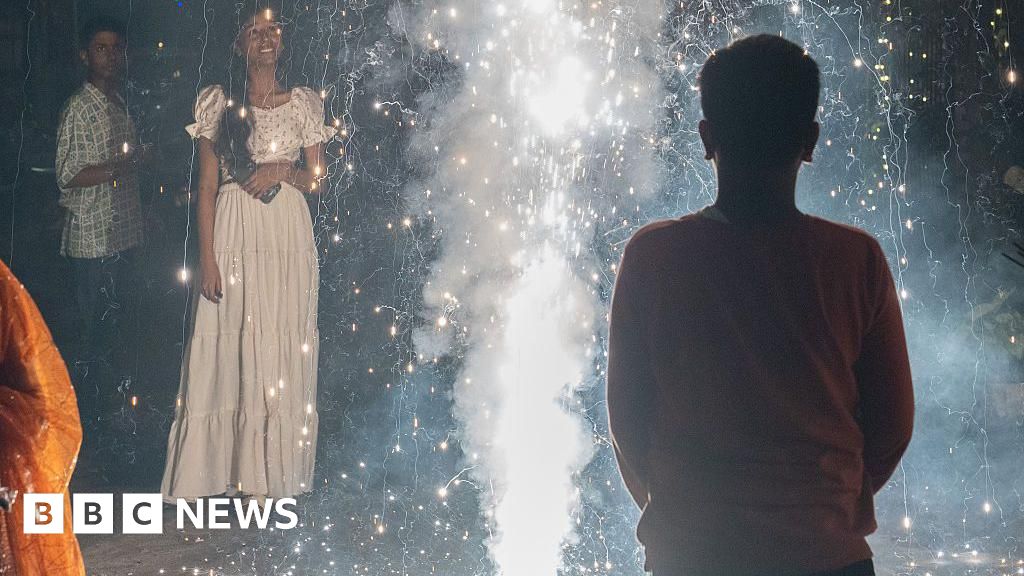
India’s capital Delhi woke as much as a poisonous haze as air high quality worsened after the Hindu pageant of Diwali, regardless of a courtroom directive to make use of less-polluting crackers.
Individuals set off fireworks in the course of the pageant, which can be noticed by Sikhs and Jains, till late on Monday, defying the courtroom’s order to make use of solely ‘inexperienced’ fireworks for a restricted time frame.
Delhi, which has excessive air pollution by way of the yr attributable to components together with vehicular emissions and dirt, had already seen air high quality dipping over the previous few days.
On Tuesday, the Air High quality Index (AQI) in Delhi was 360. The AQI measures the extent of PM 2.5 – positive particulate matter that may clog lungs and trigger a bunch of ailments – within the air.
Ranges between 101 and 200 are thought of average, whereas these between 201 and 300 are “poor”. Between 301 and 400 is categorised as “very poor” and a determine increased than 400 is taken into account “extreme”.
The World Well being Group’s pointers say that publicity to PM 2.5 over a 24-hour-period needs to be restricted to fifteen micrograms per cubic metre – however Delhi’s AQI in some components is 24 occasions increased than the advisable degree.
The town’s air pollution downside turns into worse in winter as farmers in neighbouring states burn crop stubble. Low wind speeds additionally entice pollution – akin to these produced by firecrackers – within the decrease ambiance, making it exhausting to breathe.
That is why firecrackers had been banned in Delhi and its suburbs throughout Diwali since 2020. Nevertheless, this rule was not strictly enforced on the bottom and crackers had been nonetheless out there for buy in lots of outlets, resulting in its use in the course of the pageant.
Final week, India’s Supreme Court docket relaxed the blanket ban, permitting individuals to make use of so-called inexperienced crackers, which its makers say emit 20-30% much less pollution than conventional ones and generate minimal ash. Critics, nevertheless, have identified that despite the fact that comparatively much less dangerous, these crackers nonetheless launch poisonous substances into the air.
Within the run-up to Diwali, BBC reporters noticed conventional crackers nonetheless being bought brazenly in outlets. And whereas the courtroom had allowed inexperienced crackers to be burst solely throughout a restricted window – one hour within the morning and two within the night on Diwali and the day earlier than it – the sound of fireworks may very well be heard nicely previous midnight in lots of areas.
On Tuesday, when BBC reporter Vikas Pandey left his residence in Noida, a suburb of Delhi, at round 0600 native time (0030 GMT) to catch an early morning flight, he realised “the acquainted odor of burning charcoal was again”.
“The air was stuffed with smoke and visibility was poor. I might style ash in my mouth. Because the taxi entered Delhi, visibility turned even poorer. The tall buildings that are often seen at this hour had disappeared behind a thick veil of smog,” he says.
Consultants are frightened that the enjoyable of guidelines round crackers might have an effect on consciousness across the risks of air air pollution which was being developed over the previous few years.
To make sure, Delhi’s air high quality was already within the “very poor” class, with AQI crossing 300, for round every week now, attributable to a number of components akin to low wind pace, vehicular emissions and stubble burning in neighbouring states.
On Sunday, officers invoked the subsequent stage of the Graded Response Motion Plan (GRAP) in Delhi and its suburbs, imposing restrictions on using diesel mills and burning of coal and firewood in a bid to enhance air high quality.
For now, because the acquainted smog descends on Delhi, its residents seem resigned.
“You’ll be able to’t even consider stepping outdoors. The state of affairs appears to be equally unhealthy in densely populated areas and rural areas in Delhi at present,” mentioned Paras Tyagi, who lives within the capital.
Observe BBC Information India on Instagram, YouTube, Twitter and Facebook.
