

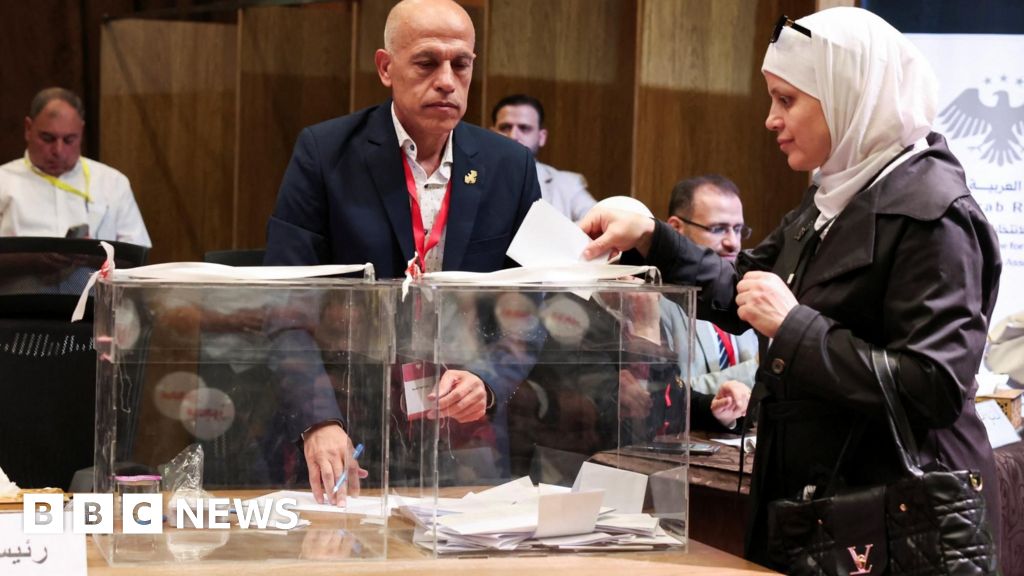
The committee which organised Syria’s first parliamentary elections because the fall of Bashar al-Assad has acknowledged “vital shortcomings”, after outcomes confirmed solely 13% of the seats contested had been received by feminine and minority candidates.
Observers stated six girls and 10 members of spiritual and ethnic minorities had been among the many 119 folks elected to the brand new Individuals’s Meeting on Sunday.
There was no direct well-liked vote. As an alternative, electoral faculties are choosing representatives for two-thirds of the 210 seats. Interim President Ahmed al-Sharaa is appointing the remaining.
An election committee spokesman stated the president’s decisions may “compensate” for the underrepresented elements of society.
Twenty-one seats weren’t stuffed as a result of the polls had been postponed for safety causes in two Kurdish-controlled provinces within the north, and a 3rd within the south which has seen lethal preventing between authorities forces and Druze militias.
Sharaa declared that the elections had been a “historic second” throughout a go to to a polling station and stated the parliament would play an “essential oversight function” throughout its 30-month time period.
He promised a democratic and inclusive political transition after his Sunni Islamist group led the lightning insurgent offensive that overthrew the Assad regime final December, ending a 13-year civil battle that killed greater than 600,000 folks and displaced one other 12 million.
Nonetheless, the nation has been rocked by a number of waves of lethal sectarian violence since then, fuelling worry and mistrust amongst minorities.
Sunday’s polls had been overseen by the Increased Committee for the Syrian Individuals’s Meeting Elections, whose 11 members had been chosen by the president in June.
They, in flip, appointed sub-committees which had been tasked with choosing as much as 7,000 members of 140 electoral faculties overlaying 60 districts.
The candidates representing the 50 districts the place voting passed off all needed to be electoral school members. Supporters of “the previous regime or terrorist organisations” had been barred from membership, as had been advocates of “secession, division or searching for international intervention”.
Ultimately, girls made up 14% of the 1,500 candidates, based on the Increased Committee.
Nonetheless, there have been no quotas for feminine lawmakers, nor for these from the nation’s many ethnic and spiritual minorities.
After publishing the preliminary election outcomes on Monday, increased election committee spokesman Nawar Najmeh was requested by journalists to touch upon the illustration of girls and Christians.
“Among the many most important shortcomings of the electoral course of had been the unsatisfactory outcomes for Syrian girls’s illustration, and the truth that Christian illustration was restricted to 2 seats, a weak illustration relative to the variety of Christians in Syria,” he instructed a information convention.
Election observers instructed Reuters information company that two members of Assad’s Alawite sect and a number of other ethnic Kurds additionally received seats.
The US estimates that 10% of Syria’s 24 million inhabitants is Christian. Sunni Muslims represent 74%, different Muslim sects 13%, and Druze 3%.
Najmeh steered that “the president’s third [of the seats] may compensate” for some underrepresented elements of society.
He additionally insisted that authorities had been “severe about having supplementary ballots” within the northern provinces of Raqqa and Hassakeh, that are principally managed by a Kurdish-led militia alliance, the Syrian Democratic Forces (SDF).
Nonetheless, he stated the polls there can be linked to progress between the federal government and the SDF on the implementation of a March settlement to combine all Kurdish-led army and civilian establishments into the state.
The Syrian Democratic Council (SDC), the political umbrella of the SDF-affiliated Autonomous Administration of North-East Syria (AANES), stated the elections “didn’t signify the Syrian folks’s will, and didn’t signify all areas and communities within the nation”.
On Tuesday, Defence Minister Murhaf Abu Qasra stated he had agreed to a complete ceasefire with the SDF’s chief, Mazloum Abdi, following current clashes in two Kurdish-majority neighbourhoods of the northern metropolis of Aleppo.
The AANES accused the military of attacking residents of Ashrafieh and Sheikh Maksoud on Monday, whereas the inside ministry stated the clashes erupted after the SDF shelled military checkpoints.
The federal government additionally holds little sway within the southern province of Suweida, the place tensions with the predominantly Druze inhabitants have remained excessive because the sectarian violence there three months in the past.
The violence erupted when Druze militias clashed with Sunni Bedouin tribes, which prompted the federal government to ship its forces to intervene. Greater than 1,000 folks had been killed within the preventing, most of them Druze, based on monitoring teams.
One Druze cleric in Suweida, Fadi Badria, instructed the UK-based Syrian Observatory for Human Rights the elections represented solely the authority of what he known as the “terrorist” interim authorities, and that they’d “not be recognised by the province”.
