

Paul KirbyEurope digital editor and
Laura Gozzi

 Reuters
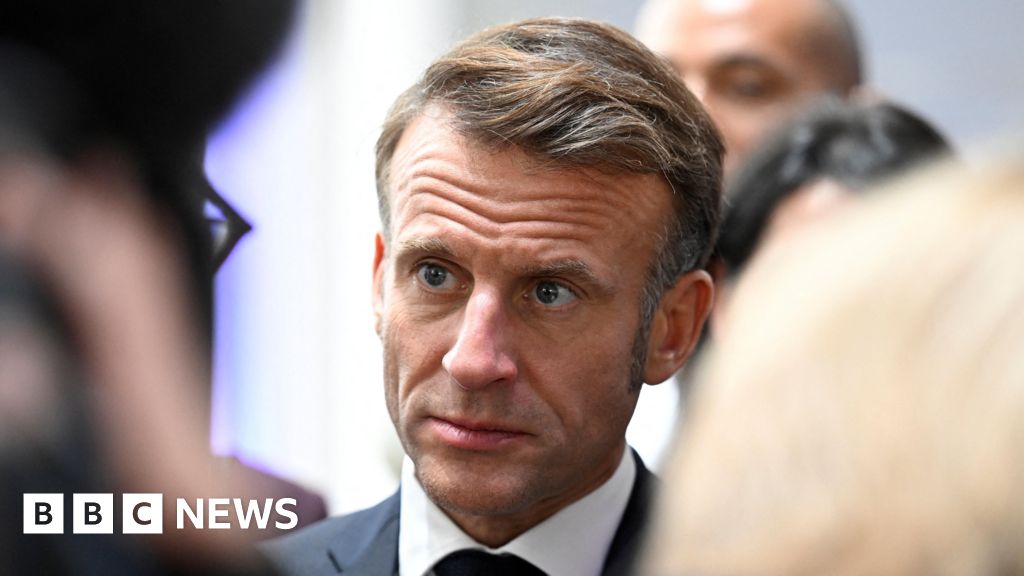
After eight years in workplace, Emmanuel Macron’s place as president is coming below growing strain as France’s political disaster escalates.
Macron as soon as known as himself maître des horloges – grasp of the clocks – however his command of timing shouldn’t be what it was. For the third time in a 12 months his alternative of prime minister has resigned, and opinion polls recommend virtually three-quarters of voters suppose the president ought to step down too.
Lengthy-time ally Édouard Philippe, who served as Macron’s first prime minister from 2017-20, has urged him to nominate a technocrat prime minister and name presidential elections in an “orderly method”.
However Macron is extra prone to dissolve parliament than step down.
How did we get right here?
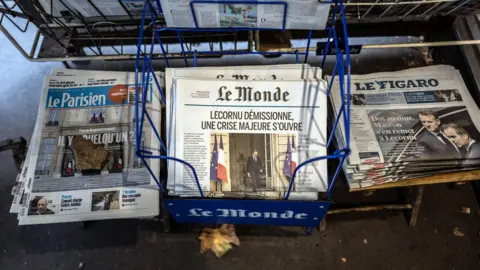
Prime Minister Sébastien Lecornu introduced his resignation firstly of a day of political drama on Monday, after solely 26 days within the job.
Hours later he mentioned he had accepted Macron’s request to remain on for one more 48 hours to carry last-ditch talks with political events “for the soundness of the nation”.
The surprising twists had been the most recent in a protracted collection of upheavals that started with Emmanuel Macron’s resolution to name a snap parliamentary election in June 2024. The end result was a hung parliament through which Macron’s centrist companions misplaced their majority and needed to search alliances with different events.
The chief of a kind of events, Bruno Retailleau of the conservative Republicans, pulled out of Lecornu’s authorities 14 hours after it was introduced.
 EPA
EPAIt is all about France’s debt
The massive problem dealing with Lecornu and his two predecessors has been the best way to deal with France’s crippling nationwide debt and recover from the ideological divisions between the centre-ground events who could possibly be a part of a authorities.
Early this 12 months public debt stood at €3,345 billion, or virtually 114% of financial output (GDP), the third highest within the eurozone after Greece and Italy. France’s finances deficit this 12 months is projected to hit 5.4% of GDP.
Michel Barnier and François Bayrou lasted solely three and 9 months respectively earlier than being ousted in confidence votes as they tried to deal with the deficit with austerity budgets.
Lecornu didn’t even make it so far as presenting a finances plan. Criticism poured in from all sides as quickly as he introduced his cupboard on Sunday afternoon and by Monday morning he had determined his place was untenable.
He blamed his departure on the unmovable stance of events who, he mentioned, “all behave as if they’d a majority”.
All of the events have a watch on the subsequent presidential votes in 2027, and they’re additionally gearing up for the potential of snap parliamentary elections in case Macron dissolves parliament once more.
Who’re the important thing figures on this disaster?
The leaders who’ve been calling on Macron to resign for months are on the laborious proper and radical left.
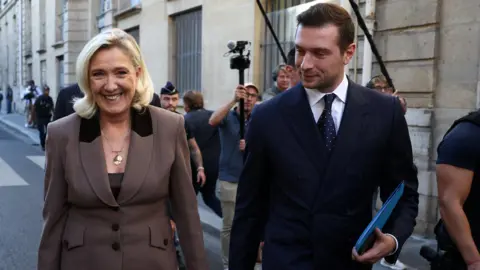
Marine Le Pen and her younger lieutenant within the far-right Nationwide Rally, Jordan Bardella, are prepared for elections and have refused Lecornu’s invitation to speak.
Jean-Luc Mélenchon of the novel left France Unbowed (LFI) has been agitating for Macron’s impeachment, though that appears unlikely. He’s backed by the Greens.
Olivier Faure’s centre-left Socialists had been allied to the novel left over the last elections however have been speaking to Lecornu provided that he kinds a left-wing authorities.
Then there may be Gabriel Attal, who leads Macron’s personal centrist Renaissance get together, however has mentioned he now not understands the president’s selections.
And on the centre-right is Bruno Retailleau, whose Republicans have been a part of the so-called socle commun (widespread platform) with the centrists.
 Reuters
What occurs now?
Lecornu has been deep in discussions with get together representatives and has till Wednesday night to current a “platform of motion and stability” to Macron.
There are 4 choices – and none of them look good.
- If Lecornu manages to steer the centre-ground events to type some form of authorities, then Macron will be capable of identify a brand new prime minister, whoever that’s. Lecornu has indicated he doesn’t want to tackle the job, though that isn’t a definitive no. The omens should not nice. When he resigned on Monday Lecornu mentioned: “I used to be prepared for compromise however all events needed the opposite get together to undertake their programmes of their entirety.” However France does have to move some form of 2026 finances to deal with its nationwide debt, and the factions know that.
- If Lecornu fails, the Elysee has indicated that Macron would “take duty”. That may most likely imply contemporary parliamentary elections, which might spell dangerous information for his centrist allies and the Socialists however would profit Marine Le Pen’s hard-right Nationwide Rally specifically. Elections would wish to happen a most of 40 days after parliament is dissolved – which might imply voting in November.
- Macron’s presidency ends in 18 months however he’s dealing with growing calls to step down. He has repeatedly rejected early presidential elections, however it’s not out of the query. Former Macron minister Benjamin Haddad argues that his resignation would make no sense as the subsequent president would simply face the identical downside: “The political divide is right here to remain.”
- Even and not using a authorities settlement, the events may put apart their variations in parliament and are available to a compromise on a restricted finances. However French politics shouldn’t be identified for its tradition of compromise.
Has Macron run out of highway?
After his third prime minister up to now 12 months introduced his resignation on Monday, Macron went for a protracted stroll alongside the River Seine, his cell phone to his ear.
A stunt for the cameras? Maybe, however it was symbolic of the solitary nature of his place, as he confronts a few of the hardest selections of his presidency and a few of his former allies seem like deserting him.
However the president could have identified for a while of the political challenges forward and he isn’t one to surrender and not using a battle – or one other bid to stabilise an more and more ungovernable France. There’s a sense that point could also be working out for the grasp of the clocks.
