


 Ayo Bello / BBC
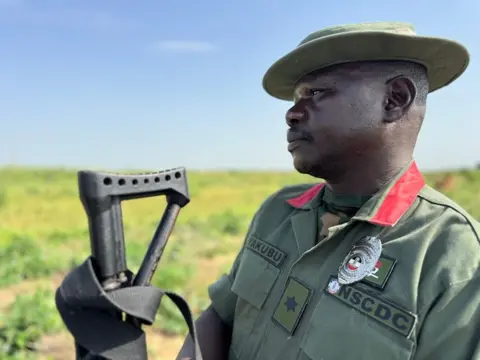
As ladies water greens and uproot weeds in a rural nook of north-eastern Nigeria, males in uniform stand guard close by holding enormous rifles.
They’re Agro Rangers – a particular safety unit arrange by the federal government to defend farmers from militants from jihadist teams Boko Haram and Islamic State West Africa Province (Iswap), who can strike farms in Borno state at any time.
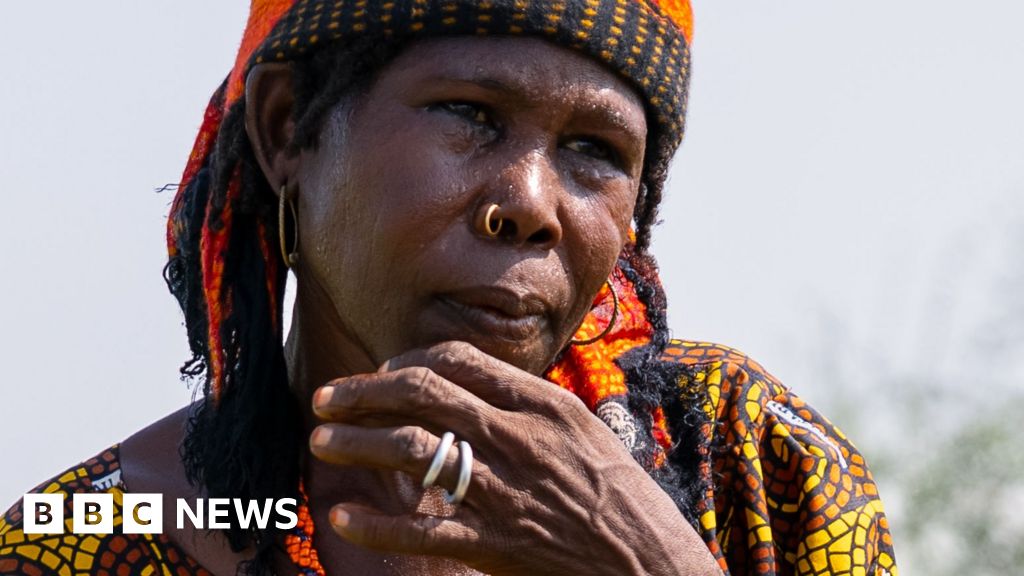
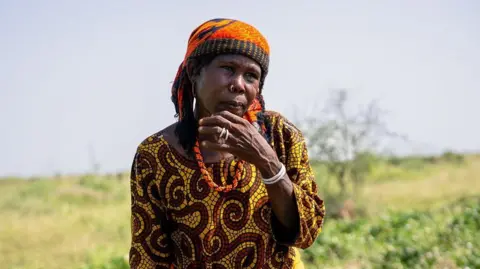
“There may be concern – we concern for our souls,” Aisha Isa, 50, tells the BBC as she tends to her crops.
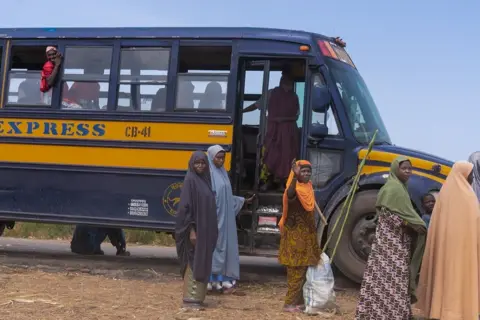
As a result of it’s now not secure for her household to reside within the dwelling they fled 11 years in the past, she and lots of others like her are bussed into Dalwa village from a pick-up level within the state capital, Maiduguri, early within the morning. It’s lower than an hour’s drive away.
She now lives in momentary housing, and rising beans and maize stays the one approach for her to feed her household, she says.
“We’ll take the chance and are available even when the rangers will not be coming.”
Right here, the navy has marked out a stretch of land, surrounded by clearly outlined trenches, the place individuals can plant their crops. In the event that they enterprise past that border, the specter of Boko Haram looms massive.
“Now we have been listening to persons are being kidnapped,” says 42-year-old Mustapha Musa. “Some are killed. That’s the reason I am scared and do not need to come with out safety safety.”
The daddy of 10 says he left his village, Konduga, 13 years in the past and won’t resettle there till the federal government brings about lasting safety.
Within the 15 years for the reason that Islamist insurgency started in north-eastern Nigeria, hundreds of individuals have died and hundreds of thousands have been compelled from their houses.
The variety of individuals killed in focused assaults on farmers this yr has greater than doubled since 2024, in line with analysis by the Armed Battle Location and Occasion Information (Acled) monitoring group.
But the governor of Borno state is rushing up the reintegration of displaced individuals from camps again onto the land – as a part of his stabilisation agenda, and to counter disruptions in meals manufacturing.
 Ayo Bello / BBC
Nearly 4 million individuals face meals insecurity throughout battle zones in Nigeria’s north-east, the UN warns. However some assist businesses say transfer to relocate farmers to spice up agriculture has moved too quick.
Worldwide Disaster Group, a non-profit organisation centered on resolving lethal battle, says the coverage is placing internally displaced individuals in peril -highlighting that militant teams extort farmers in areas that it controls to lift funds for its violent extremism.
Kidnapped together with 9 different farmers and nonetheless terrified lengthy after the ordeal, Abba Mustapha Muhammed has seen first-hand what occurs when victims don’t pay up.
“There was one which obtained killed as a result of he could not pay the ransom. His household couldn’t meet the time given,” says Mr Muhammed. “He was killed and thrown away. They requested the household to return and take the useless physique.”
Being held captive in dense forest for 3 days was “insufferable”, he says. “The small meals they ready usually left us feeling hungry and gave us diarrhoea. There was no clear consuming water.”
The daddy-of-three tells the BBC he’s too afraid to return to subsistence farming as a result of “the insurgents are nonetheless lurking. Simply yesterday, they kidnapped over 10 individuals”.
 Ayo Bello / BBC
Regardless of tales like these, Mohammed Hassan Agalama, the commander who leads the Agro Rangers scheme in Borno, insists that the guards deter militants from staging violent assaults.
“Now we have not encountered extra terrorists coming to assault the farmers as a result of they know that we’re totally on floor on the time of farming season,” says Cdt Agalama, who operates beneath the Nigeria Safety and Civil Defence Corps (NSCDC).
James Bulus, a spokesperson for the NSCDC, argues that the federal government is making positive aspects in its struggle towards the insurgents, telling the BBC: “The harvest alone is there to let you know that normalcy has returned, and farmers are doing their regular companies within the farm.”
Nevertheless, he admits that sources are insufficient.
Agro Rangers is a small-scale challenge and never a long-term resolution for widespread regional insecurity.
“We can’t be in every single place. We’re not spirits. Can 600 armed Agro Rangers cowl the entire of farms in Maiduguri? No.”
For that reason, Nigeria’s federal authorities says it plans to broaden the Agro Rangers scheme.
Acled’s senior Africa analyst Ladd Serwat says this yr has seen a surge within the variety of reported civilian fatalities as a result of focused assaults on farmers by armed teams.
Moreover, in the course of the first half of 2025 reported killings by Boko Haram and Iswap reached their highest degree in 5 years.
 Ayo Bello / BBC
Over in Maiduguri’s metropolis centre, a gaggle of farmers collect within the dwelling of Adam Goni, the chair of the Borno department of the Nationwide Affiliation of Sorghum Producers, Processors and Entrepreneurs.
The boys sit on rugs beneath the broad boughs of a tree, whereas two ladies sit on mats within the shade of a close-by veranda, as goats and chickens roam the compound.
The complete group has had their lives irrevocably modified by violence.
Amongst them is Baba Modu, whose 30-year-old nephew was gunned down on his farm by Boko Haram.
“It pains me a lot,” he says. “They killed people like an ant, with out regret. The killings we have skilled have been devastating, however this yr is the worst. Once I exit to farm, there is a fixed risk of being killed. I haven’t got peace of thoughts even at dwelling – I usually sleep with my eyes open, feeling like we is likely to be attacked.”
Mr Modu sinks into his chair at instances, pausing in deep contemplation. He says the fixed insecurity weighs closely on him and the group.
“Even in case you are ravenous and meals is scarce, you possibly can’t go to the farm. Once we attempt, they chase us away and even kill us. At first, they might demand a ransom once they kidnapped somebody, however now they gather the cash and nonetheless kill the individual they’ve kidnapped.”
Many farmers, like Mr Modu, say the militants can outnumber and overpower the Nigerian military once they assault.
“Generally even the safety operatives run away once they see the insurgents,” he provides.
On one facet of the compound, Mr Goni tends to a potato patch.
He tells the BBC that he has 10 hectares (24 acres) of land able to be harvested 8km (5 miles) away, however he’s terrified to collect his crops.
The proprietor of the neighbouring farm was killed on his land solely weeks in the past.
“There is not any security. We’re simply taking dangers to go there, as a result of whenever you go to farm these Boko Haram persons are there,” he says. “If you’re not fortunate, they are going to kill you.”
Mr Goni believes the navy might do extra to finish the battle.
“We’re very offended. We’re sad with what is going on. If the federal government is severe, inside a month, Boko Haram will finish in Nigeria.”
In the meantime, the NSCDC’s Mr Bulus says the navy is addressing the broader battle.
“Peace is gradual. You can’t do it in at some point. It has to bear so many processes.”
However the course of has taken too lengthy for these farmers. Greater than 15 years on, insecurity continues to plague each facet of individuals’s lives.
The BBC requested the Nigerian navy concerning the farming group’s claims that it has not achieved sufficient to guard them, but it surely has not but responded.
Extra BBC tales about Nigeria:
 Getty Photos/BBC